
PHL432H5 S – Seminar in Metaphysics: The Ineffable
Instructor: L. Fletcher R 10-1 PM
Prerequisites: 3.5 credits of PHL or by permission of the Instructor or Department.
Exclusion: PHL430H5

PHL440H5 F – Seminar in the Philosophy of Mind: Self and Objectivity
Instructor: G. Rattan T 3-6 PM
In this course we will consider issues about the self and objectivity. The course is framed by a question about deriving the self that springs from reflection on Descartes’s cogito: How does my conscious experience of thinking justify the judgment that I am a thinking thing? Within this frame, the course considers topics like Georg Lichtenberg’s criticism of Descartes’s cogito; Kant’s paralogisms; Wittgenstein’s idea that the self is the limit of the world; solipsism and the problem of other minds; the first-person concept; essential indexicality and de se attitudes; and nature and role of critical reflection in objective judgment.
Prerequisites: 3.5 credits of PHL or by permission of the Instructor or Department.

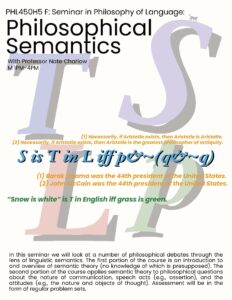
PHL450H5 F – Seminar in Philosophy of Language: Philosophical Semantics
Instructor: N. Charlow M 1-4 PM
In this seminar we will look at a number of philosophical debates through the lens of linguistic semantics. The first portion of the course is an introduction to and overview of semantic theory (no knowledge of which is presupposed). The second portion of the course applies semantic theory to philosophical questions about the nature of communication, speech acts (e.g., assertion), and the attitudes (e.g., the nature and objects of thought). Assessment will be in the form of regular problem sets.
Prerequisites: (PHL245H5 and 3.0 credits of PHL) or by permission of the Instructor or Department.
Exclusions: PHL451H5
PHL475H5 S – Seminar in Moral and Political Philosophy: Welfare and Consciousness
Instructor: M. Dimitrov T 1-4 PM
The topics of this seminar are the nature of welfare and its relationship(s) to consciousness. We begin by examining the notion of something’s being good-for someone in contrast to it being good-period. Then, we consider recent developments in the theory of welfare, before moving on to its connections to consciousness. For one, we will consider different perspectives on whether consciousness is necessary and/or sufficient for being a welfare subject (the kind of being whose existence can go well or badly). Finally, we consider whether consciousness itself is a welfare good.
Prerequisites: 3.5 credits of PHL or by permission of the Instructor or Department.

PHL489Y5 Y – Socrates Project
Instructor: D. Raffman F 9-11 AM
The Socrates Project (PHL489Y) is a full-year course with 3 components. First, you will serve as a TA for a section of PHL103H/PHL113H during the Fall and Winter terms. During the Fall semester, you will attend two 1-hour PHL103H/PHL113H lectures each week, and teach one tutorial of 20-25 students, meeting with them for 1 hour each week. You will grade their papers, hold office hours, and meet with the relevant professor as needed. You will be paid for approximately 100 hours of work at the current hourly wage for CUPE Unit 1. The second component of the course is a seminar that meets once per week for 3 hours each time, during the fall term. Most of the seminar will be devoted to more in-depth study of the topics taken up in the PHL103H/PHL113H; but you will also discuss the methods and challenges of teaching philosophy-grading papers, prompting and guiding discussion, and so forth. Third, during the winter term you will write a seminar paper, on a topic of your choosing, under the supervision of a UTM Philosophy faculty member working in the relevant area. You will also present your work orally at an undergraduate research conference. Admittance to the Socrates Project is by application only, typically near the end of the winter session. Instructions and the application form are available on the web at: http://philosophy.utoronto.ca/employment/cupe-3902-unit-1
Prerequisites: Preparation: PHL245H5 and 4.5 PHL credits preferred.
