
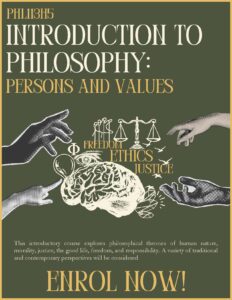
PHL 113H5F Introduction to Philosophy: Persons and Values
Instructor: Martin Dimitrov M 1-3 PM/ W 1-3 PM Delivery Mode: In-person
This introductory course explores philosophical theories of human nature, morality, justice, the good life, freedom, and responsibility. A variety of traditional and contemporary perspectives will be considered. Note: Students may take either or both PHL113H5 and PHL103H5, in any order or simultaneously. The two courses differ only in the philosophical topics they cover.
Exclusions: PHL105Y5 or PHL102H5 or PHL100Y1 or PHL101Y1 or PHL201H1 or PHLA10H3
PHL 221H5F Philosophy at the Movies
Instructor: Andrew Lavigne T 5-8 PM/ R 5-8 PM Delivery Mode: Online Synchronous
This course considers fundamental philosophical themes – the meaning of life and death, the nature of responsibility, fate and agency, knowledge and illusion, personal identity, alienation and belonging, love and sex, politics, ethics, and morality, among others – through film. The course also considers some questions about film as a philosophical genre: of the medium of film as an alternative medium (an alternative to language and explicit argument) of philosophical expression; of whether and how film may convey philosophical insight otherwise unavailable; and of the role of interpretation in understanding film philosophically.
Prerequisites: PHL101H5 or PHL102H5 or PHL103H5 or PHL105Y5 or PHL113H5 or 4.0 credits.
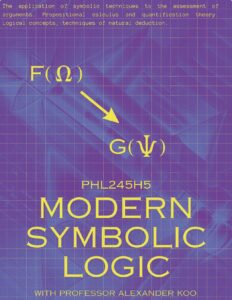
PHL 245H5Y Modern Symbolic Logic
Instructor: Marissa Bennett M 5-7 PM/ W 5-6 PM Delivery Mode: Online Synchronous Note: This half credit (0.5) course is offered over the full academic session
An introduction to formal deductive logic. Semantics, symbolization, and techniques of natural deduction in sentential logic. Symbolization, natural deduction, and models in monadic predicate logic. Symbolization and natural deduction with polyadic predicates. Introduction to advanced concepts in first-order logic, such as operations, identity, and models.
Exclusions: PHL245H1 and PHLB50H3
Recommended Prep: PHL103H5 or PHL113H5
PHL 283H5S Bioethics
Instructor: Spencer Albert M 12-3 PM/ W 12-3 PM Delivery Mode: In Person
Moral implications of recent developments in medicine and the life sciences; related legal and social issues. Euthanasia, health care priorities, abortion, fertility control, against the background of some major ethical theories.
Exclusions: PHL281Y1 or PHL281H1 or PHLB09H3
Prerequisites: PHL101H5 or PHL102H5 or PHL103H5 or PHL105Y5 or PHL113H5 or 4.0 credits.
PHL 370H5F Issues in Philosophy of Law
Instructor: Kevin Gray T 10 AM – 1 PM / R 10 AM – 1 PM Delivery Mode: In-person
Major issues in philosophy of law, e.g., responsibility and punishment, the obligation to obey the law, legal positivism, law and morality. [36L]
Prerequisites: 1.5 credits in PHL
Recommended Prep: PHL271H5 or PHL277Y5

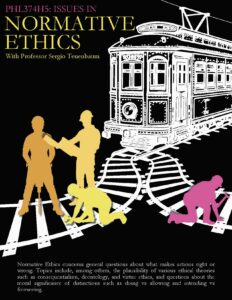
PHL 374H5S Issues in Normative Ethics
Instructor: Bowen Chan T 5-8 PM/ R 5-8 PM Delivery Mode: In Person
Normative Ethics concerns general questions about what makes actions right or wrong. Topics include, among others, the plausibility of various ethical theories such as consequentialism, deontology, and virtue ethics, and questions about the moral significance of distinctions such as doing vs allowing and intending vs foreseeing.
Exclusions: PHL375H5 or PHL376H1 or PHLC05H3 or PHLC06H3
Prerequisites: 1.5 credits in PHL
Recommended Prep: PHL275H5 or PHL277Y5
PHL 499Y5Y Individual Studies
Instructor: Nathan Charlow Delivery Mode: In Person
Individual study courses are aimed at highly motivated students. They are not intended to duplicate course offerings already available. A student seeking to do an independent course must secure a faculty supervisor. Regular meetings between student and supervisor are required, and the workload should be the same as a fourth-year philosophy seminar.